
Engaging Buying Journey: Apple Case Study
In markets for high-value products, companies often face what is known as the information paradox.
They need to present enough information to justify the price and highlight their differentiators, but too much information can overwhelm consumers and make decisions harder.
The main question becomes: how can companies present all characteristics and differentiators without overwhelming the customer?
In this case study, we use the prism of neuromarketing to explain how Apple structures information in an engaging and simplified way, encouraging customers to absorb the available information.
How do humans search for information?
Scholars argue through research that human beings search for information in a way similar to how they search for food.
This theory is called Information Foraging, and it addresses in detail the human tendency to seek information, exploring different motivations and information and research structures that directly influence the results obtained.
For a consumer to be motivated to “hunt” for information in a digital environment, it is important that this information is structured in an intuitive and engaging way, to avoid cognitive overload and motivate the customer to obtain all the information.
What is cognitive overload?
When we are engaged in an activity, we use our working memory to maintain a line of reasoning and progress toward the conclusion of that task. Cognitive overload occurs when we try to process more information than the working memory is capable of sustaining, which leads us to abandon the task or procrastinate.
Our brain possesses mechanisms to avoid cognitive overload.
One of them is dual processing, which divides the brain between System 1, which is our mode of processing information in a fast and intuitive way, and System 2, which employs great cognitive effort to solve complex problems.
Entering our analysis of Apple, we will see how the company structures product information, combining neuromarketing concepts to create an engaging and simplified journey that boosts sales.
How Apple Structures the Buying Journey
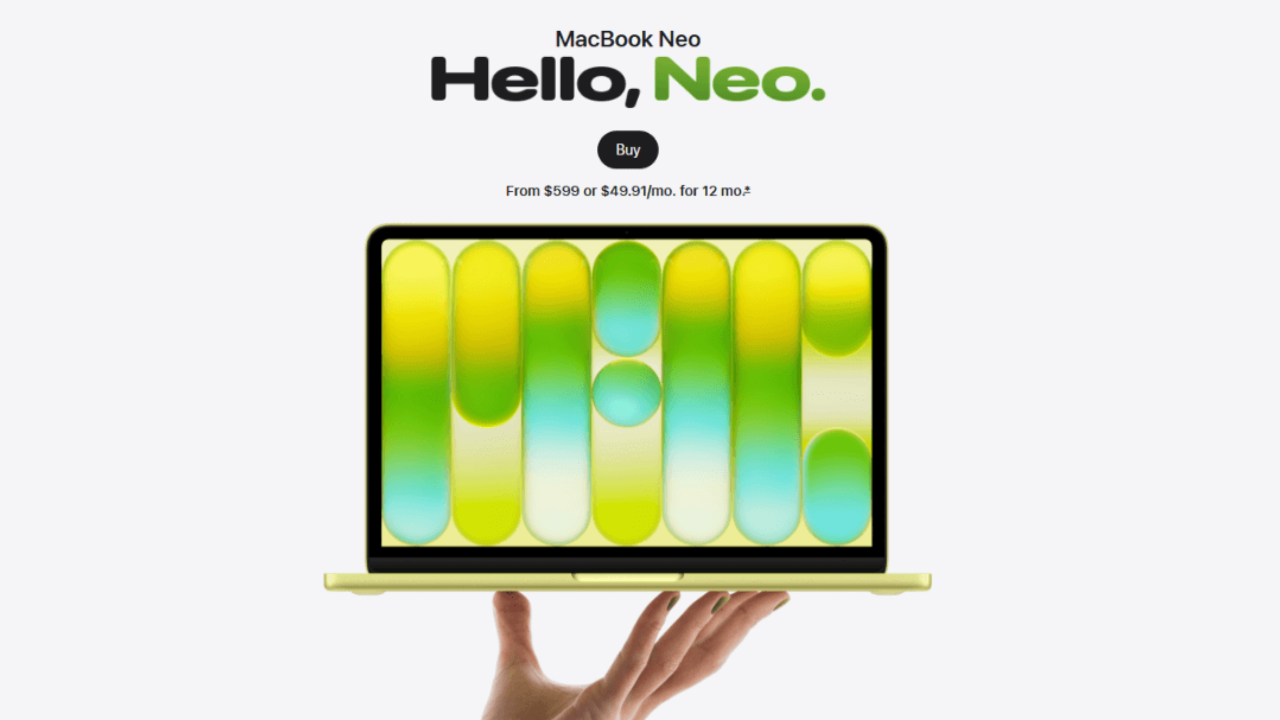
When analysing Apple's MacBook Neo page, we can notice that the information is divided and even “hidden”. As mentioned previously, for the consumer to decide to “hunt” for information, it must present itself in an intuitive and engaging way.
We can see this in a practical way: the page is rich in animations, with short texts and images of the product. In the features section, an exemplary interaction stands out.
The minimalist buttons with short texts, added to the perception of an innovative brand, function as a relevant information trail (scent), motivating the customer to click to reveal the details of the characteristic.
Upon clicking, the reader sees an animation and a short explanatory text, which brings all the reading focus to that specific characteristic, ensuring the consumer's brain only needs to worry about one feature at a time. When clicking on another characteristic, the previous one closes, generating a new animation and revealing another short explanatory text.
This dynamics leads us to another connected concept, known as Multi-Thread.
Multi-Thread: How to Isolate Information Without Losing Sight of the Rest
By isolating information with a click of the button, Apple allows the consumer to focus exclusively on one characteristic at a time. This avoids cognitive overload and provides a small cognitive reward to the customer.
However, at the same time, isolating one piece of information can make the user lose the rest of the information from the horizon, opening the possibility of that customer not going through all the available information.
Thinking about this, Apple created a structure in which the other characteristics remain in view but require a click to be revealed.
In addition to the advantages already mentioned, this mechanic creates a dopaminergic cycle of anticipation, action, and reward:
- Anticipation: the consumer wonders how the item works
- Action: the click on the button
- Reward: a sophisticated animation with a brief explanatory text
The consumer is not just reading about a product; they are also receiving small doses of dopamine, a powerful cognitive reward in product exploration journeys. With the engagement produced by these small dopaminergic cycles, we arrive at another connected concept, known as the Zeigarnik Effect.
Zeigarnik Effect: How to Make the Consumer Read to the End
The human brain has an intrinsic tendency to want to complete unfinished tasks. We can observe this effect in various activities, such as watching a series and feeling anxious when an episode ends on an emblematic scene.
Similarly, seeing a series of icons and clicking on only a few creates a cognitive tension that drives the user to click on all the items to obtain the "closure" of the experience.
By creating an engaging, intuitive, and low-cognitive-effort journey, Apple keeps the consumer motivated to seek all possible information, making them go through all competitive differentiators and increasing the perception of value in relation to the product.
How to Apply These Concepts to Your Marketing Strategy
Before addressing practice in your context, it is worth pointing out something important: the concepts seen throughout this case study repeat in varied ways in all sections of the page. Knowing this is important so that you open your mind to various ways of applying them.
When structuring the buying journey in a high-value-added market, whether on a single page or across multiple touchpoints, take the following points into consideration:
- Avoid cognitive overload: even with a large amount of information to present, consider breaking it into information fragments.
- Structure engagingly: create small dopaminergic cycles and give small cognitive rewards to the consumer, whether they are refined animations or small enlightening texts.
- Keep the path in sight: use the Multi-Thread concept so the customer doesn't lose their line of reasoning. But remember that isolating information is important to avoid cognitive overload.
- Stimulate “cycle closure”: when the experience is engaging, consumers spend more time exploring the product, which increases perceived value.
- Combine concepts in varied ways throughout the entire journey.
The purchase decision is influenced by how the consumer perceives value in your product or service.
If the perceived value is greater than the effort spent to discover it and the financial value employed, the chances of conversion skyrocket significantly. To achieve this, allow the consumer to know what you have to present, but do so strategically.
Written by Guilherme Catarino
Discover how repeated exposure influences decisions in advertising: Mere Exposure Effect in Advertising: Why Attention Matters
Join our Newsletter
Author