
McDonald's Choice Architecture: A Case Study
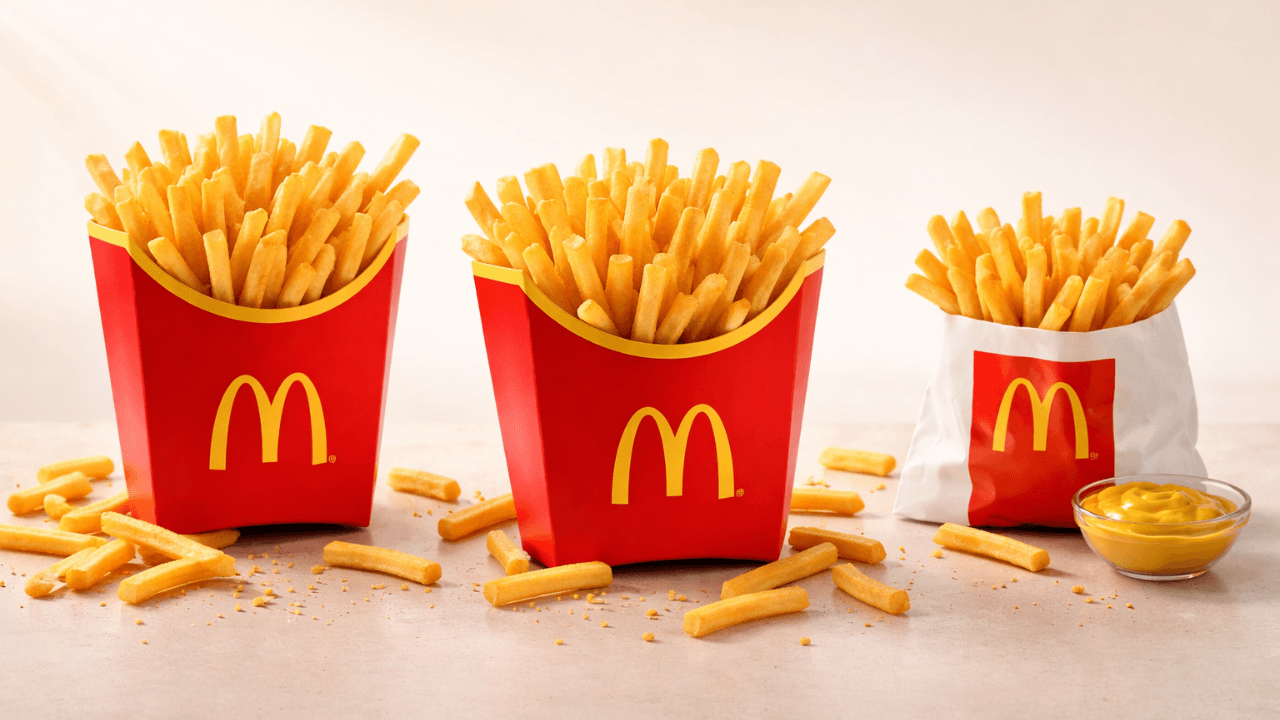
If you have ever placed an order at McDonald’s, you were probably presented with three different sizes of french fries and soda: small, medium, and large. What you may not have realized is that these three options are intentional and part of a choice architecture strategy, backed by cognitive biases.
In this case study, we will explore these concepts to understand how McDonald’s increases the average ticket of orders by helping the customer make decisions.
How does the human brain make decisions?
According to Kahneman and behavioral economics researchers, the human brain processes information through two systems: System 1, which processes in a fast, intuitive, and low-effort manner; and System 2, which processes in a systematic, deliberate way requiring high cognitive effort.
According to researchers, about 95% of daily decisions are made via System 1, optimizing time and avoiding cognitive overload. To make these decisions quickly, the brain uses "shortcuts" known as heuristics, which retrieve past experiences to avoid deliberation and solve simple problems in a simplified way.
As you may have experienced, the use of heuristics does not always lead us to the right decisions, and these errors are known as cognitive biases. These are systematic errors caused by heuristics that produce a processing predisposition. For example, in the social proof bias, people tend to take others' opinions into high account when making their own decisions, even without actually analyzing or deliberating on that opinion.
How do McDonald's use cognitive shortcuts?
Returning to our McDonald’s case, let’s analyze in detail the circumstances in which the three size options are offered to you. Typically, these options are presented in circumstances that limit your decision-making: a noisy environment, lines, hunger, too many options...
All of this sends messages to your brain, which needs to decide quickly and assertively to ensure you chose the best possible option without hindering the rest of the line behind you.
Now that we know how the brain processes information and makes routine decisions, it becomes easier to understand that McDonald’s strategy is to include heuristics in this journey so that decision-making is optimized. In this specific case, the extremeness aversion bias and the anchoring bias stand out:
- Extremeness Aversion Bias: The tendency to avoid extreme positions. In the case of McDonald’s, we can even imagine what goes through the consumer's mind, something like: "The small is too little, but the large is too much. I’ll go with the medium, you can't go wrong."
- Anchoring Bias: The tendency to process information based on previous information. In this case, the most notable anchoring is observed between the smallest and the largest, as the price difference is higher. Here we need to pay attention to some important details, as there are nuances to explore, starting with the price of the first option. Generally, the price of the smaller size is the least cost-effective, precisely so the consumer fixes their eyes on the next option. The second option is highly rewarding compared to the first; thus, the decision starts to point toward that option. However, the third option is usually rewarding compared to the second; for a slightly higher cost, the customer gets much more of the product. If you are already familiar with behavioral economics, you must have noticed by now that we have entered a famous concept: the decoy effect.
What is the Decoy Effect?
Researcher Dan Ariely conducted a study detailed in the book Predictably Irrational.
In the study, Ariely tested the introduction of a third option to change the perception of what people perceive as a "good deal." Basically, two situations were tested: in the first, people had two choices for the product; in the second situation, a third choice was added.
The result was enlightening: when submitted to a choice between two options, people generally chose the smaller one; on the other hand, when submitted to a choice between three options, people generally chose between the second or third option. This effect became known as the decoy effect (or asymmetric dominance effect) and is part of the choice architecture strategy.
How to apply these concepts to your strategy?
The practical application of this effect is observed in various sectors: fast food, SaaS, courses, among others. You can explore it in several ways, but here are two ways directed at different objectives:
- To increase the average ticket: If the goal is to increase the average ticket, the structure follows the rationale mentioned earlier. The first option is the least advantageous; its goal is to anchor the cost-benefit ratio to make the second option extremely advantageous. However, the third option is only slightly more expensive than the second but delivers a considerable amount; thus, the third becomes very advantageous compared to the second, leading the consumer to choose the third option due to the perception of cost-benefit.
- To drive toward a more profitable product: The most expensive option is not always the most profitable for the business (we see these cases in SaaS, for example). In this scenario, the focus is to make the middle option the most attractive, provoking thoughts like: "The first is too basic, it doesn't fully meet my needs. The third has more than I need, but it's more expensive. The middle one serves me and the price is okay." Generally, this strategy is used for products considered the "flagship" of the company, whether by demand volume or profitability.
Some key points to pay attention
As you can see, a simple structuring of options can carry many details about decision-making and consumer behavior. To apply these concepts to your business, it is important that you have a defined objective for the products. If it is to increase the ticket, creating a hierarchy focused on the third product is the ideal path.
On the other hand, if the goal is to point to the most profitable product, the ideal path is to structure the extreme options as less advantageous or beyond what is necessary. This way, the customer perceives the middle option as the best deal.
Remember to use strategies effectively, but also ethically. If the consumer feels exploited by your approach, difficult-to-reverse negative effects can occur, damaging the company's image and the possibility of future approaches.
Written by Guilherme Catarino
Join our Newsletter
Author