
Measuring Consumer Emotions in Marketing
Current consumption relationships tend to explore more than a simple cost–benefit exchange between consumer and supplier, extending to perceptual, psychological, social, and even emotional factors.
You have probably heard at some point that eliciting emotions has become a notable competitive advantage for many companies, and that the future of marketing depends on the consumer’s emotions.
But how can we measure the audience’s emotions to know whether a campaign’s objectives will be achieved? Before answering this question, it is necessary to briefly clarify how emotions are measured in the field of consumer neuroscience.
The “traditional” theory of emotion
The dominant theory of emotion in psychiatric research assumes that human beings are evolutionarily endowed with a discrete and limited set of basic emotions (Ekman, 1992; Panksepp, 1998; Tomkins, 1962, 1963).
According to these theorists, each emotion operates individually in behavioral, psychological, and physiological manifestations, without influence from others, and arises from the activation of specific neural pathways in the central nervous system (CNS).
From this perspective, sadness, for example, produces feelings related to the activation of specific neural pathways, and similarly, other emotions are activated by distinct and specific pathways. In short, the theory proposes that each emotion is reproduced through the activation of its single corresponding neural system.
Recent findings from affective neuroscience have raised significant questions about basic emotion theory. The neural bases of basic emotions have not yet been validated, peripheral physiological correlates of these emotions have not been established, and no specific facial expressions have been identified that are uniquely associated with each basic emotion.
Taken together, these limitations leave basic emotion theory, so far, without sufficient empirical grounding to define which emotions are truly basic (Ortony & Turner, 1990). Clinicians and researchers have long observed the difficulty people have in assessing, distinguishing, and describing their own emotions (Saarni, 1999).
Given this difficulty, it is assumed that individuals do not experience or recognize emotions as isolated and discrete entities but rather as ambiguous and overlapping experiences. Similar to the color spectrum, emotions seem to lack clear boundaries that sharply differentiate one emotion from another (Russell & Fehr, 1994).
According to Watson and Clark (1992), experimental participants rarely report a specific positive emotion without also mentioning another positive emotion. These intercorrelations among emotions are extensively addressed in dimensional models of affect, which consider affective experiences as a continuum of highly interrelated and often ambiguous states.
The two-dimensional models
Extensive studies of these intercorrelations have led to two-dimensional (2D) models of affective experience (Larsen & Diener, 1992). These dimensions have been conceptualized in different ways: positive and negative affect (Watson et al., 1999), tension and energy (Thayer, 1989), approach and withdrawal (Lang, Bradley, & Cuthbert, 1998), or valence and arousal (Russell, 1980).
Despite the different labels, the 2D structure is consistently found across many studies. In interpreting this bidimensional structure, proponents of the circumplex model of affect suggest that affective states arise from two independent neurophysiological systems. For the purposes of applied discussion, we will refer to these as the valence and arousal systems, following Russell.
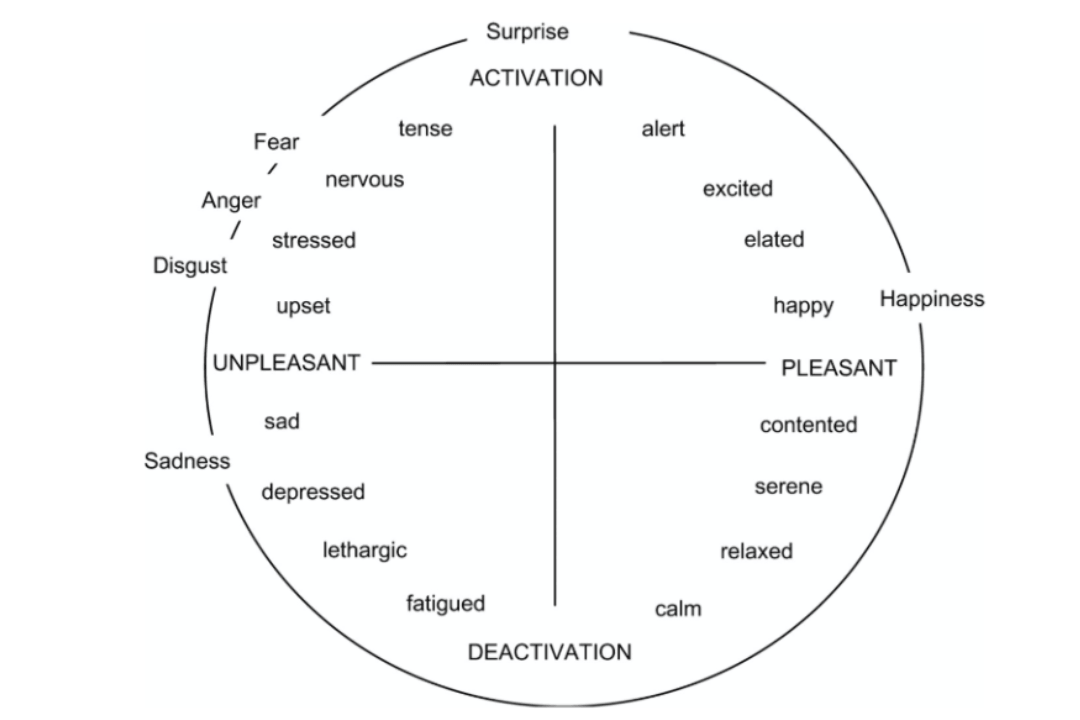
Each affective experience originates from a combination of these two systems, thus representing a specific emotion. Fear, for example, is conceptualized by circumplex theorists as a neurophysiological state involving the combination of negative valence and high arousal in the central nervous system.
As emotions are experienced and communicated, cognitive interpretations are used to identify neurophysiological changes in the valence and arousal systems and to conceptually organize these changes in relation to eliciting stimuli, memories of prior experiences, behavioral responses, and semantic knowledge (Russell, 2003). We can therefore view emotions as the product of an interaction between cognitions, likely occurring mainly in neocortical structures, and physiological changes related to the valence and arousal systems, which are largely supported by subcortical structures.
The image below shows a matrix of valence (x-axis) and arousal (y-axis). Emotions are positioned according to their valence (positive or negative) and arousal (in an increasing scale).
Russell`s (1980) Circumplex Model
A case of emotion measurement
Moving into practical implications, it is important to emphasize that measuring emotions in neuromarketing is not limited to asking “which emotion did you feel?”, but rather to mapping affective dimensions in a way that is aligned with brain functioning.
Instead of working only with discrete labels (happiness, anger, sadness), recent research shows that it is possible to capture the consumer’s emotional experience in terms of pleasure versus displeasure, arousal versus calm, and, to a lesser extent, dominance versus submissiveness, and to relate these dimensions to specific patterns of neural activity while the person watches advertisements.
In the study conducted by Morris et al. (2009) with TV commercials and fMRI, participants evaluated each ad using a nonverbal visual scale (AdSAM) that measures pleasure, arousal, and dominance immediately after exposure. These scores were then compared with BOLD signals observed in regions such as the prefrontal cortex, temporal gyri, and areas associated with valence and arousal. The results showed that ads rated as less pleasurable (such as the Anti-Fur commercial, with more aversive content) activated neural patterns distinct from those associated with more pleasurable ads, while high-arousal stimuli (Anti-Fur and Gatorade) were associated with greater recruitment of regions involved in processing motion and dynamism.
In other words, differences in pleasure and arousal reported by consumers were mirrored by consistent differences in brain activity.
These evidences reinforce two central ideas for consumer neuroscience. First, that emotions in advertising are better understood as configurations of valence and arousal than as isolated “boxes” of joy, anger, or fear.
Second, that well-designed dimensional instruments, such as visual PAD scales, can serve as a reliable bridge between consumer self-report and underlying neural mechanisms, offering more structured metrics for evaluating the emotional effectiveness of campaigns.
In practice, this means that when designing and testing communication pieces, companies can go beyond simply asking whether people “liked it or not” and measure, scene by scene, whether the ad is generating the desired pattern of pleasure and arousal in the brain, precisely the emotional coordinates that tend to sustain attention, memory, and ultimately purchasing behavior.
Written by Guilherme Catarino
References
EKMAN, P. An argument for basic emotions. Cognition & Emotion, v. 6, n. 3–4, p. 169‑200, 1992.
PANKSEPP, J. Affective neuroscience: the foundations of human and animal emotions. New York: Oxford University Press, 1998.
TOMKINS, S. S. Affect, imagery, consciousness: Volume I. The positive affects. New York: Springer, 1962.
TOMKINS, S. S. Affect, imagery, consciousness: Volume II. The negative affects. New York: Springer, 1963.
ORTONY, A.; TURNER, T. J. What’s basic about basic emotions? Psychological Review, v. 97, n. 3, p. 315‑331, 1990.
SAARNI, C. The development of emotional competence. New York: Guilford Press, 1999.
RUSSELL, J. A.; FEHR, B. Fuzzy concepts in a fuzzy hierarchy: varieties of anger. Journal of Personality and Social Psychology, v. 67, n. 2, p. 186‑205, 1994.
WATSON, D.; CLARK, L. A. On traits and temperament: general and specific factors of emotional experience and their relation to the five‐factor model. Journal of Personality, v. 60, n. 2, p. 441‑476, 1992.
LARSEN, R. J.; DIENER, E. Promises and problems with the circumplex model of emotion. In: CLARK, M. S. (ed.). Review of Personality and Social Psychology: Emotion. Newbury Park: Sage, 1992. p. 25‑59.
WATSON, D.; WIESE, D.; VAIDYA, J.; TELLEGEN, A. The two general activation systems of affect: structural findings, evolutionary considerations, and psychobiological evidence. Journal of Personality and Social Psychology, v. 76, n. 5, p. 820‑838, 1999.
THAYER, R. E. The biopsychology of mood and arousal. New York: Oxford University Press, 1989.
LANG, P. J.; BRADLEY, M. M.; CUTHBERT, B. N. Emotion, motivation, and anxiety: brain mechanisms and psychophysiology. Biological Psychiatry, v. 44, n. 12, p. 1248‑1263, 1998.
RUSSELL, J. A. A circumplex model of affect. Journal of Personality and Social Psychology, v. 39, n. 6, p. 1161‑1178, 1980.
RUSSELL, J. A. Core affect and the psychological construction of emotion. Psychological Review, v. 110, n. 1, p. 145‑172, 2003.
MORRIS, J. D. et al. Mapping a multidimensional emotion in response to television commercials. Human Brain Mapping, v. 30, n. 3, p. 789‑796, 2009
Join our Newsletter
Author