
Social Proof and Rewards: Shopee Case Study
If you shop online, you may have heard about the giant Shopee, consolidated as one of the biggest e‑commerce platforms in the world. Shopee emerged in February 2015 in Singapore and was a pioneer in the mobile‑first e‑commerce concept (adapted for smartphone journeys).
With concept innovation and a gamified platform, expansion happened rapidly, reaching its current level of operations in 13 different countries.
There are several factors that explain its accelerated growth and customer loyalty, but one of the most notable is its rating and rewards system.
In this Shopee case study, we will analyze this system through the lens of neuromarketing to understand how to increase sales volume and build customer loyalty through the rating and rewards system.
How cognitive processing, heuristics and biases affects decision making
According to Kahneman, the human brain operates through two systems: System 1 (fast, intuitive, emotional) and System 2 (slow, deliberate, analytical). Of all the decisions made by a person, about 95% are attributed to System 1, with the goal of optimizing resources (time and energy) and ensuring that our deliberate reasoning is employed in situations of real need, thus avoiding cognitive overload and mental exhaustion.
For these decisions to be made quickly and with little effort, the human brain uses cognitive shortcuts known as heuristics. In general, heuristics are a powerful advantage for humans because, as mentioned earlier, they allow us to save time and cognitive effort for truly complex activities; however, we do not always make accurate decisions using heuristics, and these systematic errors are known as cognitive biases. Heuristics and biases are classified according to their nature and impact on decision‑making.
Knowing about the existence of these shortcuts and systematic errors that occur in the human brain, brands look for ways to exploit this in their businesses to enhance their results. This was the case with Shopee, which, by thinking about the use of the social proof bias, found an even more effective way to self‑reinforce a rating and reward system by integrating the reciprocity bias into a gamified platform.
How the system of social proof and reward works
When making a purchase in e‑commerce, it is common for people to look for references and reviews, after all, remote purchasing makes it impossible to see or touch the product in person. The usual path is to go to the product page and view the reviews, trying to understand whether the product is well ranked or not. After analyzing the reviews and reaching a conclusion, the person begins to track the order inside the platform and through the store’s communications.
When the long‑awaited order arrives, Shopee takes advantage of this moment of euphoria to ask for something simple: rate the purchase. The customer, taken by the euphoria of receiving the product, rates it and submits the review to the platform, which then displays it on the product page. Consequently, other people will see this positive review added to so many others, and their purchase will be influenced by the social proof bias.
This bias acts as a friction reducer, especially related to trust. As mentioned earlier, remote purchasing makes it impossible to see and touch the product in person and, in addition, the buyer often does not know the seller.

Social proof thus serves as a trust point that silently answers the questions of the undecided consumer: it worked for them, it will work for me; the order really arrived, the seller is trustworthy; so many people have already bought it, I also deserve it. By doing a simple reflection exercise, we can see the power of the social proof bias in the purchase decision‑making process.
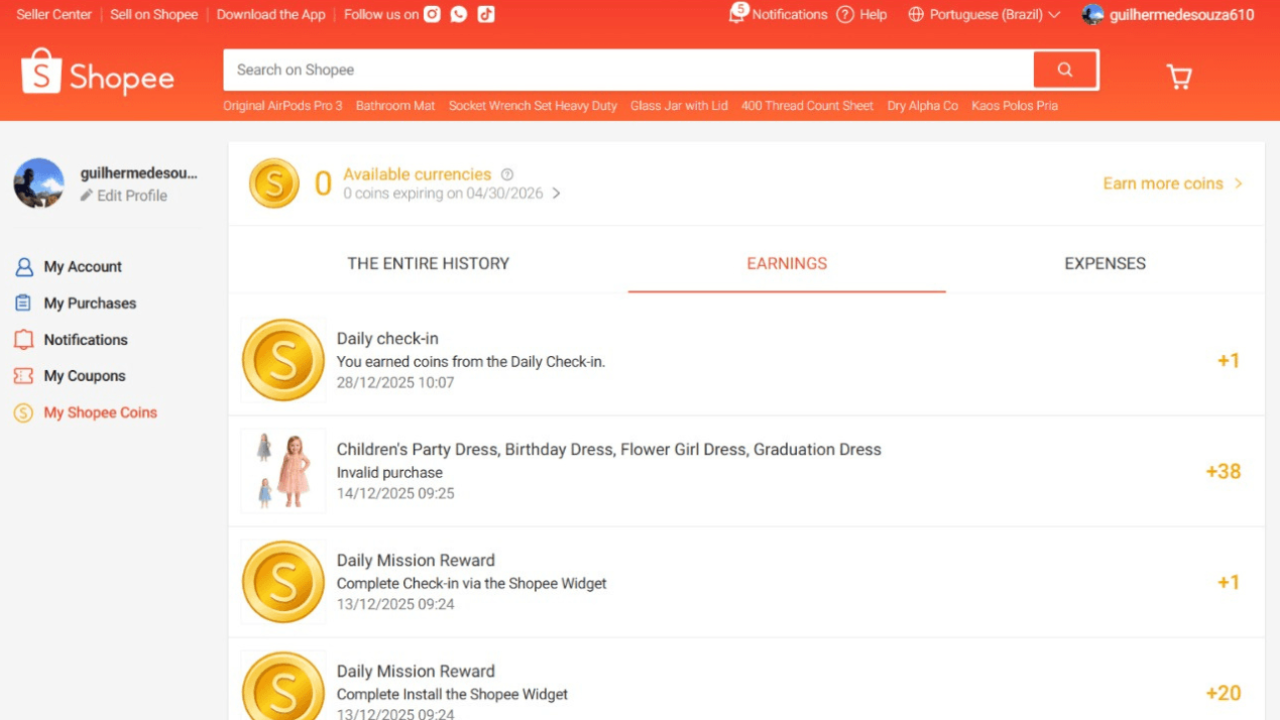
In addition to social proof, Shopee managed to go one step further and create a self‑reinforcing system, further boosting revenue growth and building stronger customer loyalty. When rating a purchase, people earn coins that can be exchanged for discounts within the platform. These coins can be accumulated, guaranteeing attractive discounts that induce the customer to make a new purchase.
As if the incentive were not enough, we can also observe another bias at play: reciprocity. By receiving a reward for their review, the customer feels “indebted” to the company and is induced to repay this favor through a new purchase. When making this new purchase, the customer submits another review; accumulates more coins; buys more; reviews again; earns coins, and the cycle repeats.
How to use this Shopee strategy in our business?
With this well‑designed and executed strategy, we can see that knowing concepts is important, but knowing how to connect concepts is revolutionary.
Social proof is already used by many companies, and results are certainly enhanced by its use; however, the extra step taken by Shopee in connecting the reciprocity bias and gamification was able to create a self‑reinforcing network that: reduces friction (mainly trust‑related) in the purchase decision through a large number of product reviews; encourages customers to leave reviews through rewards that turn into discounts; increases purchase recurrence through the incentive obtained by the customer via the review.
When designing a review strategy for your customers, take into account a few points:
- The moment when you request the review: at the moment when the customer receives the product, when an expectation has been exceeded…
- The approach used when requesting the review: formal and rigid requests can seem uninteresting and purely corporate; contextual approaches and gamification are good ways to make the process more engaging.
- What comes after the review: what your customer gains by reviewing the product, and how they use that reward.
- How this network is self‑reinforced: many companies use active processes, such as phone calls; this process can be labor‑intensive and completely dependent on human actions. Looking for ways to automate so that the network becomes self‑reinforcing is a good way to scale operations.
The digital market is broad, competitive, and also heavily studied. Isolated actions can have an impact, but connecting actions and different concepts, linked to a broader strategy, can create a significant advantage over the competition.
Written by Guilherme Catarino
Related case study:
How McDonald's Uses Choice Architecture to Increase Sales
Join our Newsletter
Author